History Of Compass:
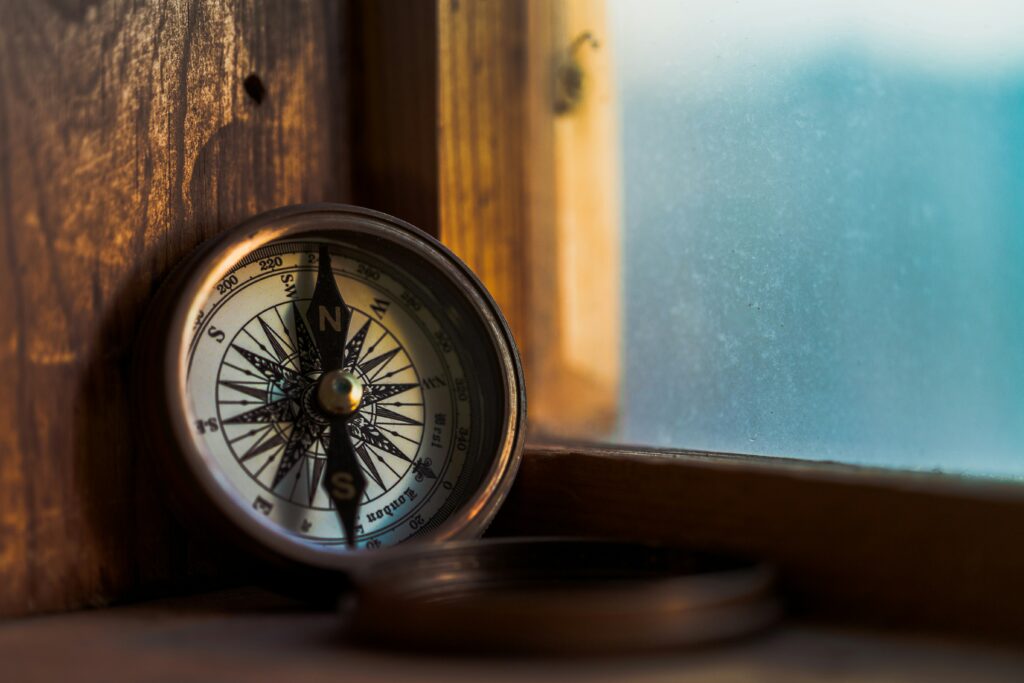
The story of the compass is one of the most remarkable journeys in the history of human discovery — a tale woven through time, science, exploration, and innovation. A Timeless Journey from Lodestone to Smartphones. It all began thousands of years ago, when curious minds in ancient China discovered a mysterious rock called lodestone. This naturally magnetized mineral had the peculiar ability to align itself north-south when freely suspended. Fascinated by this magical property, early inventors crafted the first crude compasses — floating pieces of magnetized iron in water — to guide their ships through fog and night, when stars and coastlines offered no help. It was a small step that would one day change how the world moved. From there, the compass quietly transformed the world.
For centuries, humanity has been guided by an unending quest to understand its place in the world. From the early days when travelers relied on the position of the sun and stars, to the invention of the magnetic compass that revolutionized navigation, our ability to find direction has shaped civilizations and inspired exploration.
Ancient mariners once gazed at the North Star to cross vast oceans. With time, the Chinese discovery of magnetism led to the creation of the first compasses — simple lodestones floating on water. These early instruments evolved through Arab and European innovations into the beautifully crafted brass compasses of the Age of Discovery.
Each advancement not only improved accuracy but also expanded horizons — guiding sailors across unknown seas, traders along silk routes, and explorers toward new worlds. Today, digital compasses and satellite navigation continue that same spirit of curiosity and connection.
The story of directions is more than a tale of tools — it’s a reflection of humanity’s enduring desire to explore, adapt, and discover.
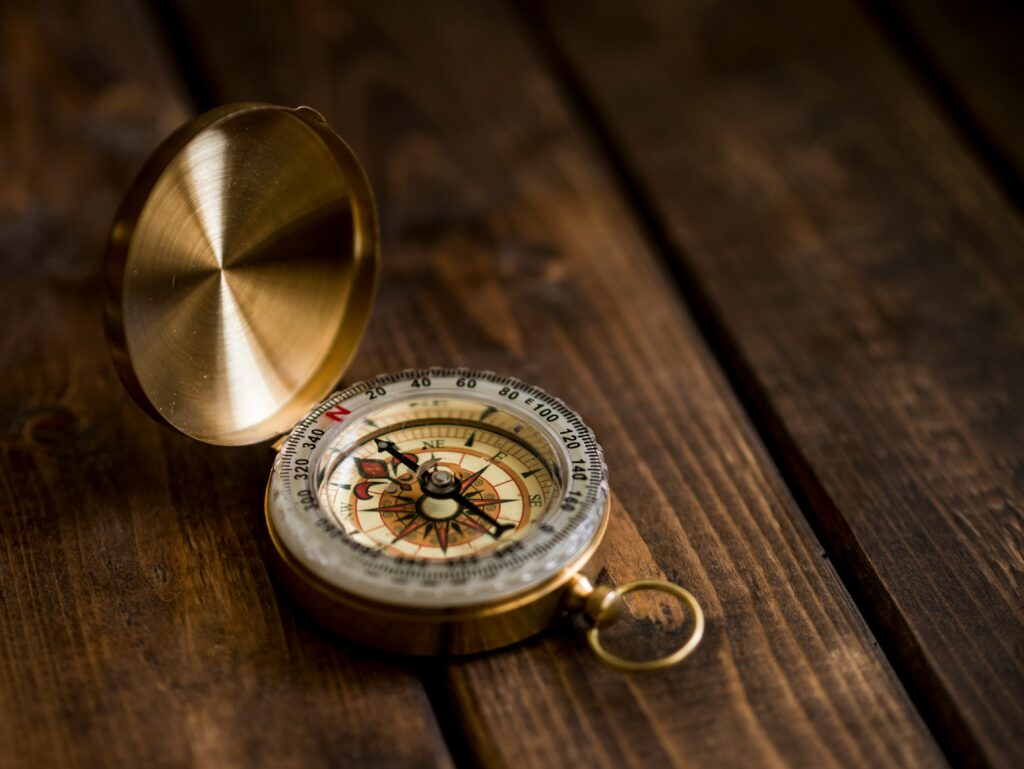
Invention Of Compass:-
🏛️ Ancient Beginnings (Before 200 BCE)
The first compasses were invented in China during the Han Dynasty (around 200 BCE). These early versions weren’t used for navigation — they were made from lodestone, a naturally magnetized mineral, and used mainly for feng shui (aligning buildings and graves with the Earth’s energy). The Chinese discovered that lodestone aligns itself with the Earth’s magnetic field, always pointing roughly north–south.
🚢 Navigation Revolution (11th–13th Century)
By the Song Dynasty (11th century CE), the Chinese began using compasses for marine navigation, especially when stars or the sun weren’t visible. The earliest nautical compasses were floating devices — a magnetised needle placed on a piece of wood or cork floating in water. Knowledge of the compass spread westward through Arab traders and reached Europe around the 12th century.
⚓ Medieval Europe (13th – 15th Century)
European sailors quickly realized the compass was a game-changer for sea exploration. They refined it by mounting the needle on a pivot, so it could spin freely and point north more accurately. The compass became central to the Age of Exploration, guiding voyages by Columbus, da Gama, and Magellan across oceans.
🧭 Modern Improvements (16th–19th Century)
16th–18th centuries: Navigators developed dry compasses (needle over a card) and gimbal-mounted compasses (to stay level on ships). 19th century: The liquid-filled magnetic compass was introduced, reducing needle vibration caused by ship movement. Compasses became standard issue for navies, explorers, and surveyors worldwide.
💡 20th–21st Century: Beyond Magnetism
The invention of the gyrocompass (1908) allowed navigation without relying on magnetism — useful for steel ships and submarines. Later came digital compasses, GPS, and electronic sensors in phones, watches, and aircraft systems. Yet, even today, the magnetic compass remains a vital backup — simple, reliable, and independent of power or signal.
🌐 Symbolism and Legacy
The compass has become more than a navigation tool — it symbolizes direction, guidance, and discovery, both literally and spiritually. From ancient China to modern smartphones, it represents human curiosity and the quest to explore the unknown.
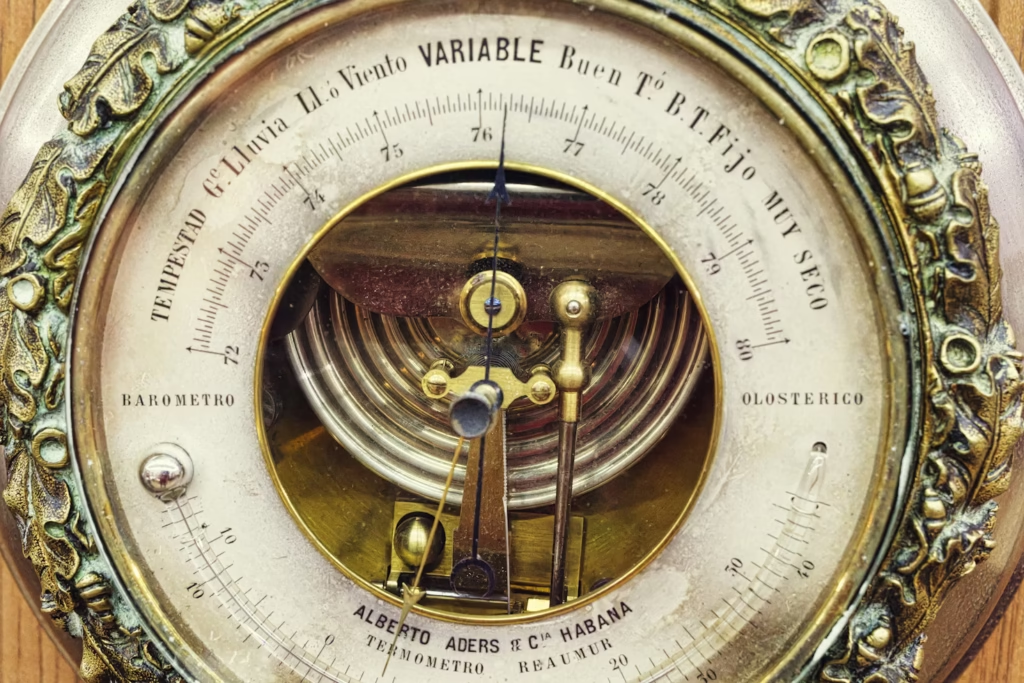
Mechanism Of A Compass:
Basic Principle – Earth as a Giant Magnet:
- The Earth acts like a huge bar magnet with a magnetic north pole and a magnetic south pole.
- Magnetic field lines flow from the Earth’s magnetic south pole to magnetic north pole (opposite to the geographic poles).
- A magnetized needle in the compass aligns itself parallel to these magnetic field lines.
Result:
The compass needle always points towards the Earth’s magnetic north, helping you find direction.
Main Components of a compass:
| Part | Function |
| Magnetized needle Pivot or jewel bearing | Aligns with Earth’s magnetic field, one end points north allows the needle to rotate freely with minimal friction. |
| Compass Card or dial | Marked with directions (N,S, E,W) and degree (0°–360°). |
| Base plate / Housing | Protects the needle and provide a stable surface. |
| Liquid (in liquid-filled compass) | Dampens vibrations so the needle stabilizes quickly |
How it Works — Step-By-Step:
- The needle is magnetized — one end becomes the north pole, the other the south pole.
- When the compass is held level, the needle freely rotates on its pivot.
- The magnetic north end of the needle aligns itself with Earth’s magnetic north.
- The dial or compass housing shows directions relative to where you’re facing — you can then determine your heading or bearing.
Correction Factors:here are a few real-world factors that affect compass readings:
- Magnetic Declination:
The difference between true north (geographic) and magnetic north — varies by location and changes over time.
(Navigators correct this using local declination maps.) - Magnetic Deviation:
Caused by nearby metal objects, magnets, or electronics that distort the magnetic field.
Modern Variants:
- Digital compass (electronic): Uses magnetometers or sensors to detect the magnetic field and display direction on screens.
- Gyrocompass: Works based on the Earth’s rotation, not magnetism — used in ships and aircraft.
In Short:
A compass works because its magnetized needle aligns with Earth’s magnetic field, always pointing toward the magnetic north.
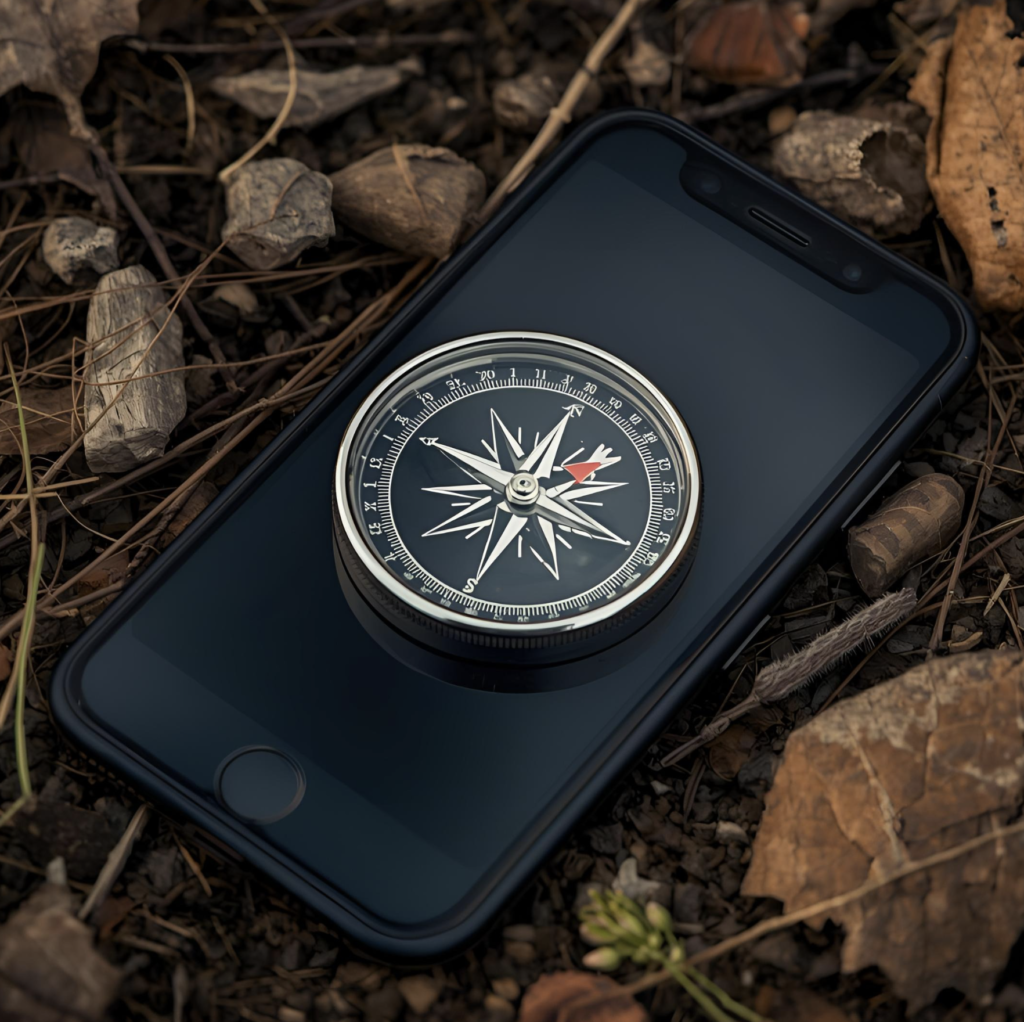
Evolution From Lodestone To Smartphone:
A tale woven through time, science, exploration and innovation. It all begun thousands of years ago when curious mind in ancient China discover a mysterious rock called lodestone. This naturally magnetised mineral had the peculiar ability to align itself north-south when freely suspended. Fascinated by this magical property, early inventors crafted the first crude compasses – floating pieces of magnetized iron in water – to guide their ships through fog and night, when stars and coastlines are offered no help. It was a small step that would one day change how the world moved. From there the compass quietly transformed the world.
20th-21st Century: Beyond Magnetism
The invention of the Gyrocompass (1908) allow navigation without relying on magnetism – useful for steel ships and submarines. Later came Digital Compass, GPS and Electronic Sensor in phones, watches and aircraft systems. Yet, even today, the magnetic compass remain a verbal backup – simple, reliable and independent of power or signal.
Symbolism and Legacy:
The compass has become more than a navigation tool – it symbolise direction, guidance and discovery, both literally and spiritually. From ancient China to modern smartphone, it represents human curiosity and the quest to explore the unknown.
This was such a fascinating and wonderfully written piece! You’ve managed to take a scientific topic like the compass and turn it into a truly engaging journey through time. I really loved how you connected ancient discoveries with modern technology — from lodestone to smartphones — in such a smooth, story-like flow.The historical details were clear and well-organized, and the blend of science, history, and symbolism made the blog feel both educational and inspiring. It’s amazing how you captured the compass not just as a tool, but as a symbol of human curiosity and exploration.Keep writing and sharing more of these insightful stories — your ability to make learning feel like adventure is genuinely impressive!
Hi Mayur,
Thankyou so much for your very fascinating and kind reply.
Quite informative & engaging to read. Keep it up.
Hi Abhijeet,
Thnakyou so much for your fascinating and kind reply.